
Maryn McKenna

Journalist and Author

  • Contact
  • Blog
  • Speaking and Teaching
  • Audio & Video
    • Audio
    • Video
  • Journalism
    • Articles
    • Past Newspaper Work
  • Books
    • Big Chicken
    • SuperBug
    • Beating Back the Devil
  • Bio
  • Home

From Bird Flu to Big Farms: The Rise of China's Agriculture

February 21, 2014 By Maryn Leave a Comment

Image: Willem vdh/Flickr

Image: Willem vdh/Flickr

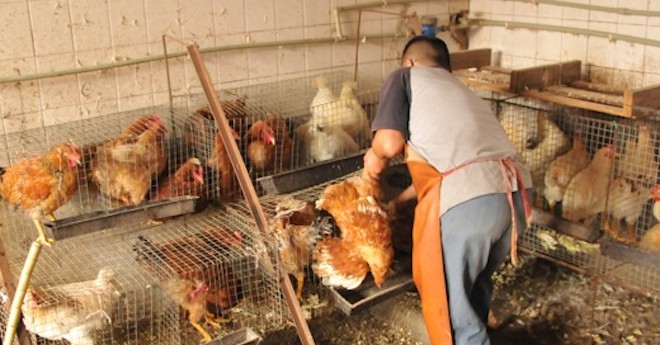
In my last post, I talked about the unnerving increase in avian flu H7N9 in China. The novel flu strain, now in its second year, appears to be spreading more rapidly than it did in its first appearance, and also more rapidly than H5N1, the avian flu strain that has caused the most worry internationally.

You can’t have avian flu — or at least, not this avian flu — without birds; most of the people who have been diagnosed with H7N9 had contact with live chickens or visited a market that sold live poultry for slaughter. H7N9 is continuing to spread in China; and so it’s a lucky coincidence that a nonprofit with deep knowledge of Chinese agriculture has just published a series of reports exploring the vast expansion of Chinese production of meat animals, including chickens.
[Read more…]

Filed Under: Science, Science Blogs, Superbug Tagged With: antibiotics, chicken, China, food policy, food safety, pigs, Resistance, Science Blogs

H7N9 Flu, Year Two: What Is Going On?

February 10, 2014 By Maryn Leave a Comment

Live-poultry market, Shandong, China, 2009. Jonas_in-China (CC), Flickr

Live-poultry market, Shandong, China, 2009. Jonas_in-China, Flickr

Cast your mind back to about this time a year ago. A novel strain of flu, influenza A (H7N9), had emerged in China, in the provinces around Shanghai. International health authorities were deeply concerned, because any new strain of flu bears careful watching — and also because, on the 10th anniversary of the SARS epidemic, no one knew how candid China would be about its cases.

By the time peak season for flu ended in China, there had been 132 cases and 37 deaths from that newest flu strain. But, confounding expectations, the Chinese government was notably open about the new disease’s occurrence, and scientists worldwide were able to ramp up to study it. Still, no one could say whether that flu would be the one to make the always-feared leap to a pandemic strain that might sweep the globe. As with other, earlier, worrisome strains of flu, science could only wait and see whether it might return.

And now it has.
[Read more…]

Filed Under: Science, Science Blogs, Superbug Tagged With: avian flu, CDC, chicken, China, flu, H5N1, H7N9, influenza, poultry, Science Blogs, Who

USDA: Chicken Processed in China Can be Sold in the US Without Labels to Say So

September 4, 2013 By Maryn Leave a Comment

source: nugget photo and poor Photoshop skills by me.

Catching up to this news, which dropped quietly just before the holiday weekend: In a first, the US Department of Agriculture has given permission for chicken products processed in the People’s Republic of China to be sold in the United States without labeling that would indicate where the chicken products came from.

The news was broken by Politico, whose writers obtained USDA documents before the agency released them, and then followed up by the New York Times, with some no-holds-barred analysis by Bloomberg Businessweek.

If you’ve been reading for a while, you’ll know that food safety in China is well below US standards. (See this post for stories of toxic vinegar, glow-in-the-dark pork, and more.) So it may be a surprise to hear that birds grown and slaughtered outside that country, but cooked and made into products in it, would be acceptable for sale here. Especially since the plants that USDA has approved for sales into the US market will not have USDA inspectors on site.

Here is the USDA notice, in the form of an audit issued by the Food Safety and Inspection Service.

[Read more…]

Filed Under: Science, Science Blogs, Superbug Tagged With: chicken, China, FDA, FSIS, poultry, Science Blogs, USDA

The "Road Not (Yet) Taken" On H7N9 Flu — And How Far We've Gotten

June 10, 2013 By Maryn Leave a Comment

Last week’s New England Journal of Medicine included a thoughtful meditation on the possibility that the new bird flu out of China, H7N9, could become a globe-spanning pandemic — and on how much knowledge is needed before we’ll be able to predict whether it will or not. The authors, all from the US National Institutes of Health, know a fair amount about pandemics: Dr. Anthony Fauci, director of the National Institute of Allergy and Infectious Diseases; Dr. David Morens, Fauci’s senior advisor and a medical historian; and Dr. Jeffery Taubenberger, a physician and microbiologist who brought back to the world the viral cause of the worst pandemic: the influenza of 1918, which killed 100 million people.

In various combinations over the past 10 or so years, the three have written a number of papers looking back at the record fro 1918, interrogating its impact, and particularly examining the causes of its extraordinary death toll. So they are probably the perfect authors to write about gaps in knowledge about H7N9.

But aside from its useful examination of the virology, what struck me as most interesting about their paper is how soon it is to be able to write something like this. After all, H7N9 only emerged to public knowledge in late February, and so far has caused 132 cases and 37 deaths, all in eastern China. That these authors could write this paper now is yet another marker, I think, of how different this outbreak is from SARS 10 years ago, as well as how rapidly international public health science can move, if everyone cooperates.

[Read more…]

Filed Under: Science, Science Blogs, Superbug Tagged With: avian flu, China, flu, H7N9, influenza, NIH, Science Blogs

World Health Organization Annual Meeting: New Flu, Coronavirus Urgent Priorities

May 20, 2013 By Maryn Leave a Comment

In Geneva today, the World Health Assembly — that is, the annual meeting of the 194 governments whose collective commitment support the World Health Organization — opened as traditional, with a speech by the WHO’s director-general, Dr. Margaret Chan. It is a very interesting time, not just for the WHA to be meeting, but for Dr. Chan to be addressing them. That’s because, 10 years ago when SARS exploded into the world from China, she was the director of health for Hong Kong, the city that was hit first and hardest. Ten years later, with H7N9 flu emerging from China, and a viral relative of SARS — the novel coronavirus now being dubbed MERS — bubbling in the Middle East, the questions and lessons of SARS are bizarrely resonant. That has been true for the past several weeks, but is even more so today, with one more case of MERS announced, in one more country: Tunisia, this time.

Here are the opening paragraphs from Chan’s speech (full text online here). To me it’s quite interesting how much she praises China for its transparency in dealing with H7N9 flu — while not extending the same praise to the Kingdom of Saudi Arabia, where MERS is concentrated. In fact, she doesn’t even mention Saudi Arabia by name; whether that is meant to give offense, or to avoid it, other public-health tea-leaf readers can say better than me. Though her closing comment — “the current situation demands collaboration and cooperation from the entire world” — sounds pretty pointed to me.

[Read more…]

Filed Under: Science, Science Blogs, Superbug Tagged With: CDC, China, coronavirus, hCoV-EMC, MERS, NCoV, SARS, Saudi Arabia, Science Blogs, transparency, Tunisia, Who

Transparency Unlocked: More New Saudi Coronavirus Cases Reported Quickly

May 4, 2013 By Maryn Leave a Comment

In my last post 36 hours ago, I raised questions about Saudi Arabia’s apparent delay in reporting new cases of the novel coronavirus that has been causing low-level unease since last summer. (For the full history of that, check these posts.) So it’s only fair to say that, within 24 hours, the Saudi government behaved very differently with a new report.

The bad news is, the new report is about yet more cases of the novel virus. But the good news is, the report of the new cases was quickly shared internationally, by the government’s Deputy Minister for Public Health, via the international disease-alert mailing news ProMED.

[Read more…]

Filed Under: Science, Science Blogs, Superbug Tagged With: CDC, China, coronavirus, H7N9, hCoV-EMC, influenza, MERS, NCoV, SARS, Saudi Arabia, Science Blogs, transparency, Who

New Diseases and National Transparency: Who Is Measuring Up?

May 2, 2013 By Maryn Leave a Comment

I’m still catching up on all the news that happened during the weeks I was away, and I had a food-policy post just about set to go today. And then this happened.

I opened my morning mail to find a note from a private list I subscribe to, published by a company that monitors hazards for businesses with expatriate employees. The note flagged new news from Saudi Arabia:

Saudi Arabia: Seven more case of novel coronavirus reported
Seven people in Al-Ahsa governate in the Eastern province have been confirmed infected with the novel coronavirus. Five have died and the other two are critically ill in intensive care. It is unclear whether there are any links between these cases or whether they are “sporadic” infections. Overall the risk to travellers remains low.

This was odd. You’ll remember the new coronavirus, distantly related to SARS, which surfaced last year in a slow and not well-disclosed manner (for the back story, see these posts from last September, October, November and December). Since the initial reveal last year, there has been very little information released about the virus and whatever illness it might be causing. The World Health Organization has been monitoring the gradual accumulation of cases, but there has been almost nothing published since last fall. In fact, though teams from Columbia University and the Centers for Disease Control and Prevention have been to the Kingdom of Saudi Arabia to help investigate the new illness, neither entity has published anything since those trips were made. And at the point at which I opened my inbox this morning, the WHO’s last update on the new virus had been published on March 26.*

Meanwhile, of course, the infectious disease world has been riveted by the rapid emergence in China of a different virus, the new avian flu H7N9, and many questions have been aimed at whether the Chinese government, which attempted to conceal the emergence of SARS 10 years ago, has learned the lesson of transparency. (I talked about that history, and how the world found out about SARS, in this segment from On the Media a few weeks ago.)

Almost since H7N9 emerged in March, though, the WHO and other bodies have been averring that China is actually doing a good job this time around. And with this overnight news from Saudi, it seems that the questions about disease-outbreak transparency may have been directed at the wrong country.

[Read more…]

Filed Under: Science, Science Blogs, Superbug Tagged With: avian flu, CDC, China, coronavirus, H7N9, hCoV-EMC, influenza, MERS, NCoV, SARS, Saudi Arabia, Science Blogs, transparency, Who

Antibiotic-Resistant Bacteria Surround Big Swine Farms — In China as Well as the U.S.

February 12, 2013 By Maryn Leave a Comment

I suspect we think of large-scale confinement agriculture as a uniquely American issue. Possibly that’s because growth-promoter antibiotic use, which makes meat-raising efficient, originated in the United States; more likely, it’s because some of the largest firms in that sector — Smithfield and Tyson, for example — are US-based. But public and private research efforts (including the US Department of Agriculture, the United Nations’ Food and Agriculture Organization and the Pew Charitable Trusts) have documented that intensive livestock-raising is increasing in emerging economies such as India and China; as incomes rise, demand for meat does too.

A paper published Monday in the Proceedings of the National Academy of Sciences demonstrates that the unintended consequences of confinement agriculture are occurring in those countries as well. A multi-national team of researchers from Michigan State University and two campuses of the Chinese Academy of Sciences found — well, I can’t put it better than their paper’s title does: “Diverse and abundant antibiotic resistance genes in Chinese swine farms.”

[Read more…]

Filed Under: Science, Science Blogs, Superbug Tagged With: agriculture, animals, antibiotics, China, food, food policy, food safety, pigs, Resistance, Science Blogs

News Round-Up: Sausage, Soil, Skeeters, Camping, China, Chimps And Other Hazards

August 31, 2012 By Maryn Leave a Comment

This has been my week: Oh, wow: I should write about that. No, wait — that. Damn, new news; I’ll blog this paper instead. Except, hold on — this one is great too…

So to solve my indecision before the week ends, here you go: Most of this week’s most interesting news, in round-up form.

[Read more…]

Filed Under: Science, Science Blogs, Superbug Tagged With: agriculture, antibiotics, China, counterfeit, drugs, food, food policy, food safety, foodborne, meat, MRSA, Reuters, russia, Science Blogs, South Korea, TB

Also Receiving Antibiotics on Factory Farms: Shrimp

February 24, 2012 By Maryn Leave a Comment

Tom Philpott of Mother Jones had a great post earlier this week looking at the vast environmental damage caused by shrimp farming in South and Southeast Asia. He takes off from a presentation at the annual meeting of the American Association for the Advancement of Science by J. Boone Kauffman of Oregon State University, which examined the destruction of coastal mangrove forests that allows shrimp farms to be established and found that shrimp’s carbon footprint is 10 times higher than that of beef cattle. Tom says:

[Read more…]

Filed Under: Science, Science Blogs, Superbug Tagged With: agriculture, animals, antibiotics, China, FDA, food, food policy, Science Blogs, shrimp, Vietnam

Government Health Agency Agrees Mega-Farms Are A Health Risk (In The UK)

November 4, 2011 By Maryn Leave a Comment

It’s very odd sometimes watching how the same issues play out in different parts of the world. The French environment ministry confidently ascribes the growth of seaweed choking its beaches to farm runoff. The European Parliament denounces the establishment of very large-scale “meat factories.” China (China!) enacts a ban on growth-promoting uses of antibiotics in agriculture.

Here in the United States, on the other hand, the government gropes unsuccessfully for a way to put controls on confinement agriculture, despite evidence of its environmental harm, while at the same time those farms grow by an estimated 4,600 hogs and 5,800 broiler chickens per day.

For more of that difference between Europe and the US, look this week to England, where the Health Protection Agency has just rejected the zoning application for a hog farm that was small by US standards, with a plan for only 2,500 sows producing about 20,000 piglets. The HPA said:

… those living up to 150 meters downwind of an intensive swine farming installation could be at risk of adverse human health effects associated with exposure to multi-drug resistant organisms. (this .pdf, p.30 of 44)

[Read more…]

Filed Under: Science, Science Blogs, Superbug Tagged With: agriculture, antibiotics, China, england, Europe, food, food policy, france, pigs, Resistance, Science Blogs

Is China Banning Growth Promoters And Do They Mean It?

October 7, 2011 By Maryn Leave a Comment

A tantalizing prospect surfaced yesterday. The Institute for Agriculture and Trade Policy in Minneapolis tweeted a link to a Sept. 13 story from an online agricultural trade journal that said, in its entirety:

China’s Ministry of Agriculture has announced a forthcoming ban on antibiotics as growth promoters in animal feed. The ban is supported by the academic community, which believes that without antibiotics in animal feed, the health of animals will be better promoted, microbes’ resistance to antibiotics will be lowered and food will become safer to eat. Recent statistics show that in 2006 China produced 210,000 tons of antibiotics, and 97,000 tons were added to animal feed. Today it is estimated that 400,000 tons are produced annually.

So, first: If this story is accurate, it would be huge news. But, second: The story lists no sources and is almost a month old; in that month, there has been no other major coverage of this decision that I can find — which means a responsible reporter (which I try to be) needs to do some digging rather than pushing the link along.

[Read more…]

Filed Under: Science, Science Blogs, Superbug Tagged With: animals, antibiotics, China, food, food policy, food safety, growth promoters, Resistance, Science Blogs

Borders are Irrelevant: Polio Returns to China

August 29, 2011 By Maryn Leave a Comment

Very bad news from China, as reported by Xinhua and confirmed by the World Health Organization: For the first time in 12 years, polio paralysis has surfaced in China. Four children, the oldest 2 years old, were diagnosed with polio in mid-July. They all live in Hotan prefecture in Xinjiang province (by weird coincidence, also the site of the latest Chinese food-safety scandal).

The generally accepted math, in polio detection, is that one verified case of polio paralysis represents up to 200 cases of silent infection. Those 200 undetected cases may not experience symptoms, but they can pass on the disease to others. As a result, one case of polio in an area that has been considered polio-free is an emergency. Four cases, as you can imagine, is much worse. [Read more…]

Filed Under: Science, Science Blogs, Superbug Tagged With: China, Nigeria, Pakistan, polio, Science Blogs, Who

Food Safety in China, and the Risk to the U.S.

August 23, 2011 By Maryn Leave a Comment

Another week, another food-safety crisis in China. Several news networks — Associated Press, Australian Press and Xinhua — report that 11 people have died and anywhere from 120 to 140 were sickened by contaminated vinegar. Stoking tensions further is the reason so many were poisoned at once: The victims live in a small village in far-west Xinjiang province and are ethnic Uighurs, the minority group whose desire for political independence from Beijing led to brutally suppressed riots in 2009. Uighurs are overwhelmingly Muslim, and most of the small village, about 150 people, had gathered for an iftar meal to break their Ramadan fast.

The poisoning appears to be due to ethylene glycol; the vinegar had been stored in barrels that previously contained antifreeze. According to the AP, investigators haven’t yet been able to say whether the vinegar was put in the barrels out of ignorance, making it a problem of accidental contamination, or deliberately by an unscrupulous producer seeking to cut corners.

[Read more…]

Filed Under: Science, Science Blogs, Superbug Tagged With: China, food, food policy, food safety, Science Blogs

WCSJ: Maybe The Biggest Disease Threat Isn't Infectious At All

July 1, 2011 By Maryn Leave a Comment

I’ve been away the past week at the World Conference of Science Journalists, a biannual gathering that brought 726 writers and broadcasters from 87 countries to Doha, Qatar. I was there to give a presentation about blogging, and also because I organized two panels on under-reported epidemics and on food and farming issues in the developing world. My panelists’ testimony was so powerful that I wanted to share some of the details.

Going into the conference, the epidemics panel was my favorite. That’s not because I cheated and made myself one of the speakers, but because it brought into public view so many of the disease-control issues that we talk about here. When I say hidden epidemics, what I mean is this: The diseases that routinely grab headlines are almost never the ones that cost society the most in illness and deaths, and also in money to control and repair them.

Think of Ebola, for instance. There has never been a case of human Ebola in the United States. And as I’ve written before, viral hemorrhagic fevers repeatedly have been imported to North America without ever starting an outbreak. Yet whenever Ebola sparks in Africa, it earns scare-font headlines here, as though it were about to rampage across the continent — even though, in all its known engagements with humans, Ebola has killed less than one-tenth of the 19,000 that MRSA, for instance, kills in the US in a single year.

I asked a set of distinguished health journalists, all friends, to come to Doha to talk about diseases that deserve headlines, but never get them. Here’s what they said:

[Read more…]

Filed Under: Science, Science Blogs, Superbug Tagged With: China, diabetes, flu, food, food policy, polio, Science Blogs

China pig crisis: Drug residues in pork

March 26, 2011 By Maryn Leave a Comment

In China, more than 2,000 tons of fresh pork and pork products — at a minimum, 4 million pounds — have been recalled because the meat has tested positive for clenbuterol, a stimulant that is illegal in food-producing animals not only in China but in Europe and the United States. Another 1.6 million pigs are being tested.

The story has been unfolding for the past week without much notice from Western media, but it has been heavily covered in China, even in English-language media there.

Clenbuterol, which lingers in muscle tissue for months and concentrates in some organs, is hazardous to humans because of its stimulant properties: It revs up the heart and gives you the shakes, and can be especially dangerous for pregnant women. (Here’s the data sheet from the Food Safety and Inspection Service.) If it sounds familiar, that’s because its stimulant qualities also make it a performance enhancer — and thus a banned drug for elite athletes, including a listing on the World Anti-Doping Agency’s Prohibited List. Tour de France winner Alberto Contador was temporarily banned from cycling this year after a positive clenbuterol test, and US Olympic swimmer Jessica Hardy was found positive for the drug in 2008 (a finding she blamed on an allegedly tainted supplement). Clenbuterol’s a common subject on body-building forums (here’s one example) for its perceived ability to build lean muscle while diminishing fat.

And that may have been the motivation in China: putting lean weight, inexpensively, on pigs.

Here’s what’s known:

On March 17, the Chinese TV network CCTV reported that 19 pigs at a slaughterhouse in Henan province, part of a lot of 689, had tested positive for clenbuterol in their urine. About 20 people — farmers, middlemen, quarantine inspectors and a buyer for the processing company, Jiyuan Shuanghui Food Co., Ltd. — were arrested.

On March 18, Xinhua News reported that the number of positive tests had grown to 52 pigs out of 1,512, on nine farms tested, and the number of people in police custody had grown to 30. Plus, the scandal had spread to a second province, Jiangsu, after 20 randomly picked pigs out of 264 from Henan tested positive at a slaughterhouse in Nanjing. Concern over the brewing scandal drew the central government’s Ministry of Commerce into the issue; the agency urged the company where the tainted pork was first found — which happens to be a subsidiary of China’s largest meat processor — to suspend production and start an internal investigation.

On March 19, the central government convened an emergency meeting of pig farmers, meat processors and food retailers, and two days later ordered provincial authorities to start a crackdown that extends to checking backyard pigs.

And on March 25, the government released its annual food safety plan and put special emphasis on banning clenbuterol and tracking down illegal users.

Notably, the more-free parts of the Chinese media are pushing the government to do more. China Daily editorialized on Thursday:

Why can’t quarantine workers go to pig farms in a random way to check the pigs? Why do they have to wait for the pig urine sent by pig raisers? Why aren’t pigs randomly checked immediately before they are butchered? What is both funny and sad is the fact that a local bureau of animal husbandry in central China’s Henan Province checked a problematic pig farm and 98.8 percent of the pigs tested were passed safe on March 15. But an investigation by reporters after the check found that the farm still feeds pigs clenbuterol, which was banned nine years ago.

The revelation that pigs are being fed growth hormones that are considered harmful to humans so the animals develop more muscle and less fat has shaken consumers’ confidence in pork, just as the melamine scandal did with milk. Anyone involved, whether pig raisers or quarantine checkers, must be brought to justice…

The general public wants to be told how problematic pigs can pass a series of tests before they are butchered and how the meat containing harmful substances can go through a series of tests and still end up in the mouths of consumers.They also want to know whether the culprits, including pig raisers who have fed pigs harmful chemicals and those who took money to turn a blind eye to the problematic pigs and meat will get the punishments they deserve.

This isn’t the first time clenbuterol has been found in pork in China. In 2009, 70 people in Guangdong province were hospitalized for stimulant poisoning after eating organ meats from contaminated pigs; in 2006, more than 300 people in Shanghai were sickened. In January, two months before this scandal surfaced, the AP’s Alexa Olesen wrote a prescient long takeout on the complexity of controlling clenbuterol abuse, especially in rural areas.

Here’s a question: Activism for safe food in the United States was arguably ignited by Upton Sinclair’s The Jungle, a novel that served as an expose of the contamination and filthy conditions he witnessed working undercover in Chicago’s meatpacking plants. There was such a public outcry at his revelations that the Pure Food and Drug Act of 1906, the first US food-safety legislation, was written and passed in the same year the book came out. The Jungle was so influential that, 105 years later, it is still in print.

I wonder: Who will write a Jungle for China? And given the repression that seems to be practiced against whistleblowers there, if anyone did, would it see print?

Flickr/JulianPTan/CC

Filed Under: Science, Science Blogs, Superbug Tagged With: agriculture, China, food, food policy, food safety, Science Blogs

New MRSA pig strain in China

November 26, 2009 By Maryn Leave a Comment

Via Emerging Infectious Diseases comes the full version of a piece of research I posted on in September that was presented at the London conference Methicillin-resistant Staphylococci in Animals: Veterinary and Public Health Implications. A new MRSA variant — not ST398 — has been spotted in pigs in China.

Luca Guardabassi and Arshnee Moodley of the University of Copenhagen and Margie O’Donoghue, Jeff Ho, and Maureen Boost of the Hong Kong Polytechnic University report that they found a pig-adapted MRSA strain in 16 of 100 pig carcasses collected at 2 wet markets in Hong Kong. By multi-locus sequence typing, the strain is ST9, previously found in pigs in France; by PFGE, they fall into categories that tend to carry the community-strain cassettes SCCmec IV and V.

Here’s the bad news: This strain possesses resistance factors that resemble human hospital-associated MRSA more than they do ST398.

Twelve isolates displayed a typical multiple resistance pattern, including resistance to chloramphenicol, ciprofloxacin, clindamycin, cotrimoxazole, erythromycin, gentamicin, and tetracyline. The remaining 4 isolates were additionally resistant to fusidic acid. … All isolates were negative for Panton-Valentine leukocidin and susceptible to vancomycin and linezolid.

The further bad news, of course, is that this is being found in Hong Kong, adjacent to China, which is the world’s single largest producer of pork, raising tens of millions of tons of pig meat per year. Most of the pigs sold in Hong Kong come from the Chinese mainland, not from the SAR. Pig surveillance for MRSA in China is practically non-existent (which is not much of a criticism since it does not exist in the United States, either). A human infection with ST9 has already been recorded in Guangzhou, the province adjacent to Hong Kong.

The question, for this strain as for all MRSA strains in pigs, is what is its zoonotic potential? Here again, the news is not good. According to Maureen Boost, who presented this research at the London conference, the isolates were obtained by the researchers from intact heads from butchered pigs; the researchers took the snouts to the lab and and swabbed them there. Pig snout happens to be a desirable meat in China; it is bought in markets, taken home and made into soup. Boiling in broth would probably kill MRSA bacteria — but home butchering of a pig snout could pass the bug on to the human cutting it up, or to that human’s kitchen environment, long before the snout ever got into the pot.

The cite is: Guardabassi L, O’Donoghue M, Moodley A, Ho J, Boost M. Novel lineage methicillin-resistant Staphylococcus aureus, Hong Kong. Emerg Infect Dis. 2009 Dec. DOI: 10.3201/eid1512.090378


Filed Under: Science, Science Blogs, Superbug Tagged With: animals, China, food, MRSA, Science Blogs, ST398

© [fl_year} Maryn McKenna | Web Design Services by Sumy Designs, LLC

Facebook
